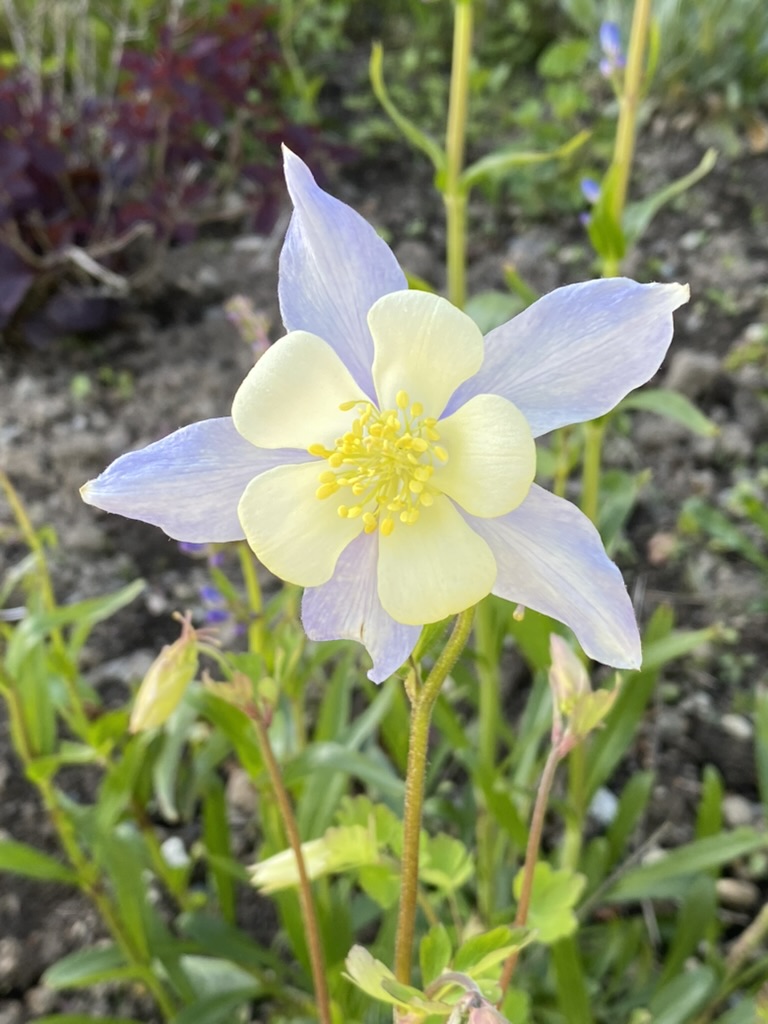
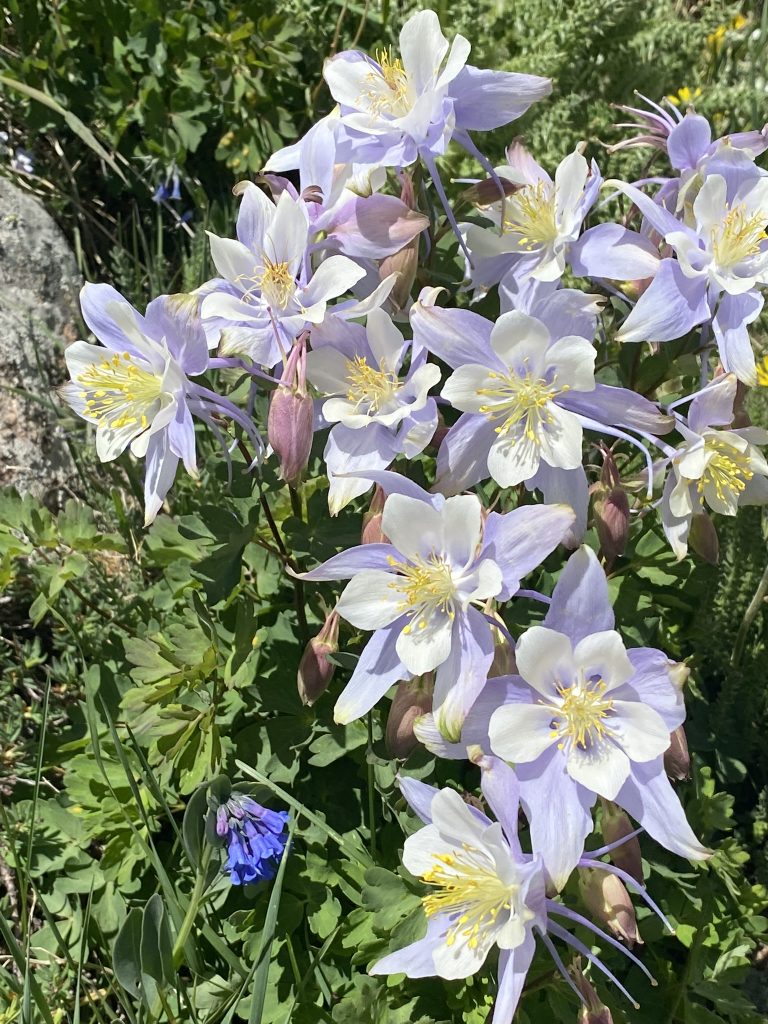
Botanically known as Aquilegia and commonly known as Columbine or even Granny’s Bonnets, this perennial is a welcome sight in spring and offers both native species and a host of cultivars to add a splash of color to spring gardens and containers.
Aquilegia originally came to North America 10-40,000 years ago during the last ice age when a land bridge from Asia to what is now Alaska allowed the spread of the ancestor of today’s American species. As that plant spread across the continent, it would adapt to its environment, and new species would emerge to better deal with encountered climate and pollinator differences.
Native species for the most part come in 3 colors: blue, yellow or red, and this is in response to the type of pollinators they can attract in the growing conditions they find themselves. Those species found in the Rocky Mountains are often blue, indicating that bumblebees are their principal pollinators as bees are particularly attracted to blue and purple flowers.
Along the western side of the US many species developed yellow flowers, with long spurs producing plenty of nectar. While still attracting bees, they were also utilizing hawk moths and hummingbirds to provide pollination. Similarly, along the eastern side of the country, red flowers evolved to also take advantage of all these pollinators, but particularly hummingbirds. In fact, the red species, which do extend westwards too, produce the most nectar of any Aquilegia species and are important food sources for migrating hummingbirds.
In addition to their charming flowers and benefits to pollinators, they also have other qualities to endear themselves to gardeners. They are hardy from USDA Zones 3 through 9 and in New England can grow readily in sun or partial shade. For those whose yards are plagued by munching critters, these plants are rabbit and deer resistant. The foliage is an attractive lacy form and sets off the flowers which are held above the mounding leaves. Even after flowering, the seedheads are a segmented vase shape and if left to ripen, will self-seed. Just be aware that seedlings do not always come true to the parent plant, but that is part of the fun to see what color the next generation is. However, if you wish to prolong their flowering season, remove spent flowers to encourage another flush of blooms.
They have various uses in the landscape – cultivars in all their forms are perfect for cottage style gardens and will do great in spring borders where other later flowers will take over. They also work well in partial shade, providing that splash of color under a light shade canopy from trees. If grown for pollinators, they provide an abundance of early nectar and A. canadensis, the Eastern Red Columbine, is perfect for fueling the ruby throated hummingbirds once they make it to New England. In addition, they make wonderful spring container plants, providing height above the lower growing spring staples. And lastly to round out their versatility, they also make great cut flowers, if you can bear to cut them!
Here at Weston Nurseries, we offer a range of cultivars as well as the species A. canadensis and sometimes A. caerulea, Rocky Mountain columbine.
A. canadensis ‘Little Lanterns’ is a compact version of our native Eastern Red Columbine. It has the same dainty red and yellow flowers but only reaches 10” tall. Perfect for rock and alpine gardens as well as containers.
A. caerulea, Rocky Mountain columbine has large bi-colored, upward-facing flowers – white petals and blue to violet sepals and spurs. Reaching between 6-31″ tall – the shorter heights being all it usually manages in its native mountains, but it will also grow happily in New England where it can reach taller heights.
However, this Columbine is one of the parents of several colorful hybrids:
Songbird series has the same large, upward flowers as its parent but in a wider range of colors, including red, yellow and pink as well as blue and purple. At up to 3” in diameter, these cultivars have the largest flowers of all Columbines. Plants reach 12-24″ tall.
Kirigama™ series also boasts upward facing flowers and a prolific range of colorful flowers. These are a little shorter, maxing out at 10-14″ tall.
Earlybird™ series are compact plants reaching 12” tall and boasting a range of vibrant colored flowers, either single or bi-colored. True to their name, they flower early and are happy growing in the cooler temperatures of New England.
In addition to cultivars derived from our native columbines, there is also a selection with European parentage (A. vulgaris), examples of which include:
Biedermeier series are compact plants about 12” tall. Also sporting an array of flower colors from white through pinks, blues and purples, these blooms have shorter spurs, which gave rise to the common name of ‘Granny’s Bonnets’.
Barlow series are an unusual, spurless form with double flowers similar in appearance to certain dahlia flowers. They were named in honor of botanist Nora Barlow, granddaughter of Charles Darwin. Her namesake variety has pink and white flowers, while Barlow Black lives up to its name by being very dark purple. Height ranges from 24-42″, depending on the variety and they bloom late spring into early summer.
These are some examples of a highly versatile spring perennial. For those looking to add color to their early spring garden, this easy-care plant is hard to beat, so why not come by your local Weston Nurseries and take a look!
Source: Columbine Natural History